
Imagine if your wireless devices could think for themselves—smartly switching channels to avoid interference and always finding the best connection for you. That’s exactly what cognitive radios do.
But did you know there are different types of cognitive radio, each designed to handle specific challenges in wireless communication? Understanding these types can help you grasp how future networks will be faster, more reliable, and more efficient. Keep reading to discover the key types of cognitive radio and how they could transform the way your devices connect and communicate.
Basic Types
Cognitive radio adapts wireless communication by sensing and using free channels. It improves spectrum use and reduces interference. Several basic types exist, each with unique features and functions. Understanding these types helps grasp how cognitive radio systems work.
Full Cognitive Radio
Full cognitive radio, also called Mitola radio, senses and understands the environment. It learns from past experiences. This radio can change many parameters like frequency and power. It aims for complete awareness and control of the wireless network.
Spectrum-sensing Radio
Spectrum-sensing radio detects unused frequency bands. It scans the radio spectrum regularly. This type avoids channels used by licensed users. It helps to use the spectrum without causing interference. It is simpler than full cognitive radio but very effective.
Adaptive Radio
Adaptive radio adjusts its transmission based on the environment. It changes settings like modulation and power. This radio reacts quickly to changes in the network. It improves communication quality and saves energy. Adaptation happens automatically without user input.
Intelligent Radio
Intelligent radio uses machine learning and decision-making. It predicts channel availability and user needs. This type can solve complex problems in real-time. It offers smarter spectrum management than other types. Intelligent radio learns and improves over time.
Heterogeneous Cognitive Radio
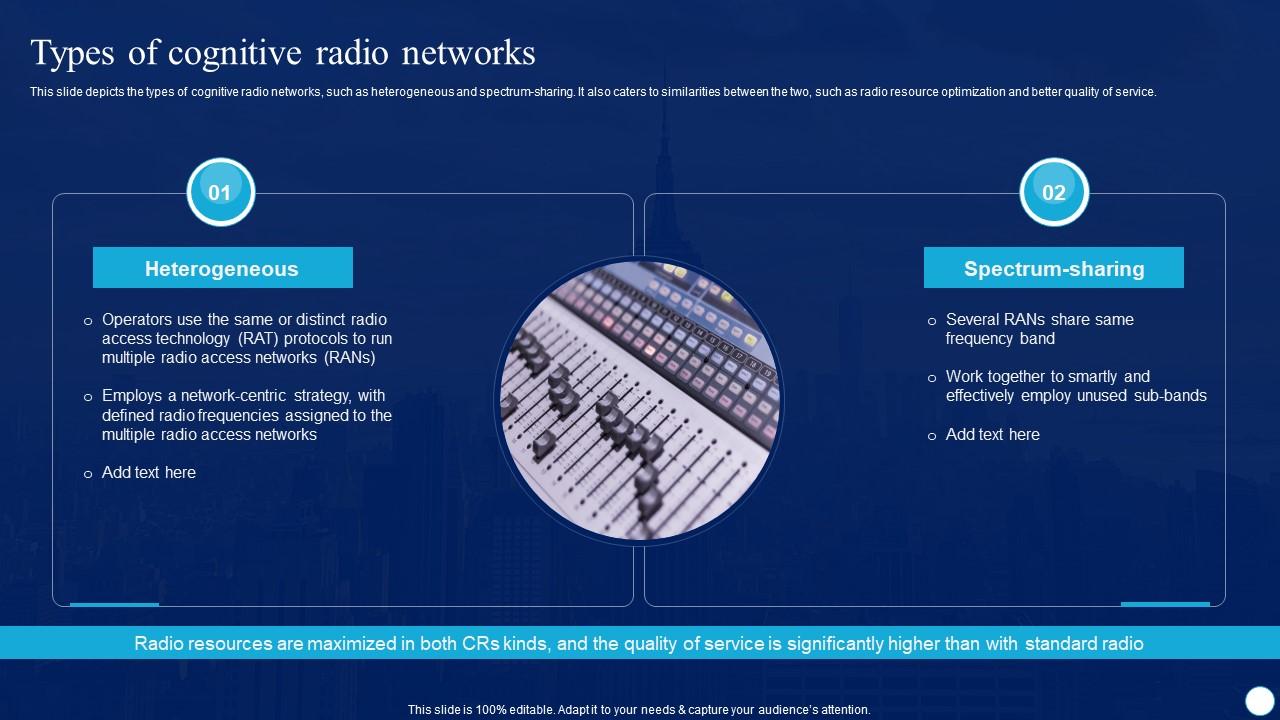
Heterogeneous Cognitive Radio blends multiple wireless technologies into a single system. It enhances communication by using different radio types together. This approach improves spectrum use and supports diverse applications.
Heterogeneous systems adapt to changing environments. They select the best communication method based on availability. This flexibility boosts network performance and reliability.
Multi-radio Integration
Multi-radio integration means combining several radios in one device. Each radio works on different frequencies and protocols. This setup helps the device switch smoothly between networks.
Devices with multi-radio integration can connect to Wi-Fi, cellular, and other systems simultaneously. They choose the strongest or least busy channel to send data. This reduces interference and improves user experience.
Cross-technology Communication
Cross-technology communication allows radios using different standards to talk to each other. For example, a Wi-Fi radio can communicate with a Bluetooth device through cognitive radio control. This breaks down barriers between wireless technologies.
This type of communication helps in smart homes and IoT networks. Devices with different radios can share information without extra hardware. It creates a seamless network of diverse devices working together.
Spectrum Sharing Models
Spectrum sharing models define how cognitive radios use the wireless spectrum efficiently. These models help unlicensed users access spectrum without disturbing licensed users. Each model uses a different approach to balance spectrum use and interference control.
Interweave Model
The interweave model allows cognitive radios to use spectrum holes or unused frequencies. Radios scan the band and transmit only when the channel is free. This avoids interference with licensed users by transmitting in gaps. It requires fast and accurate sensing to detect free channels.
Underlay Model
In the underlay model, cognitive radios transmit simultaneously with licensed users. They keep power low to avoid causing interference. This model relies on strict power control and distance limits. It works well for short-range communication with minimal impact on primary users.
Overlay Model
The overlay model lets cognitive radios transmit while helping licensed users. Radios use advanced techniques to share resources and reduce interference. They may send part of the primary user’s data or use coding methods to improve spectrum use. This model requires complex coordination but increases overall efficiency.
Software Defined Radio
Software Defined Radio (SDR) plays a key role in cognitive radio technology. It uses software to control radio functions that traditional radios handle with hardware. This design allows radios to adapt quickly to different signals and frequencies. SDR forms the foundation for smart, flexible communication systems.
Role In Cognitive Radio
SDR enables cognitive radios to sense and analyze the radio environment. It processes signals digitally, making it easier to detect unused channels. Radios can then switch frequencies without human help. This ability reduces interference and improves spectrum use. SDR acts as the brain behind cognitive radio’s intelligent decision-making.
Flexibility And Reconfigurability
SDR offers great flexibility by using software updates to change radio behavior. It removes the need for physical hardware changes. Radios can adapt to new standards or protocols through simple software changes. This reconfigurability helps devices stay up-to-date and compatible. SDR supports multiple communication methods on a single device, saving cost and space.
Network Types
Cognitive radio networks adapt to spectrum availability to improve wireless communication. They use different network types to manage how devices share the spectrum efficiently. Understanding these network types helps clarify how cognitive radios operate and coexist.
Primary And Secondary Users
Primary users have licensed access to specific frequency bands. They have priority and guaranteed rights to use these bands.
Secondary users access the same bands without a license. They use the spectrum only when primary users are inactive. This avoids interference and maximizes spectrum usage.
Secondary users sense the environment to detect free channels. They must vacate the channel immediately if a primary user returns. This dynamic sharing enhances spectrum efficiency.
Two-tier Network Architecture
This architecture divides the network into two layers. The upper layer consists of primary users with licensed spectrum rights.
The lower layer includes secondary users who opportunistically access unused spectrum. They rely on sensing and coordination to avoid conflicts.
Two-tier architecture allows coexistence of licensed and unlicensed users. It supports flexible spectrum access and better utilization.
Coordination between tiers ensures primary users experience minimal disruption. Secondary users gain access without causing harmful interference.
Applications
Cognitive radio technology adapts wireless communication to improve efficiency. It detects free channels and uses them without interfering. This ability makes it useful in many areas. Below are key applications where cognitive radios play a vital role.
Emergency Communications
Cognitive radios help maintain communication during disasters. They find open channels when networks are busy or down. This keeps rescue teams connected in critical moments. The radios use less power, which is vital when resources are limited. Their easy setup allows quick deployment in emergencies. Reliable contact saves lives and coordinates aid efforts.
Dynamic Spectrum Access
Cognitive radios enable dynamic use of the spectrum. They sense which frequencies are free and switch automatically. This reduces congestion on popular channels. It also allows better use of unused spectrum bands. Dynamic access improves overall network performance and user experience. It supports the growing demand for wireless data without extra infrastructure.
Wireless Sensor Networks
Cognitive radios enhance wireless sensor networks by improving communication links. They adapt to changing conditions and avoid interference from other devices. This leads to more stable and efficient data transmission. Sensors can operate longer by saving battery power. Applications include environmental monitoring, smart cities, and industrial automation. The technology ensures reliable data flow in complex settings.
Frequently Asked Questions
What Are Cognitive Radios?
Cognitive radios are smart wireless devices that detect unused channels and switch to them instantly. They avoid interference with licensed users and optimize spectrum use.
What Are The 4 Types Of Radio Waves?
The four types of radio waves are long wave, medium wave, short wave, and ultra-short wave. Each type varies in wavelength and application.
What Is The 3 3 3 Rule For Radio?
The 3 3 3 rule for radio means speaking in 3-second phrases, pausing for 3 seconds, and repeating key info 3 times. This improves clarity and understanding.
What Are The Four Types Of Radio?
The four types of radio are AM (Amplitude Modulation), FM (Frequency Modulation), Digital Audio Broadcasting (DAB), and Internet Radio. Each type offers unique features for audio transmission and reception across various platforms.
Conclusion
Cognitive radios come in various types with unique features. Each type helps improve wireless communication by using available channels smartly. These radios reduce interference and make better use of the spectrum. Understanding their differences aids in choosing the right one.
As technology grows, cognitive radios will play a bigger role in networks. They offer efficient, flexible solutions for future wireless needs. This knowledge helps everyone grasp how wireless systems evolve and adapt.