
Are you ready to boost your amateur radio experience but unsure which antenna fits your needs best? Choosing the right antenna can make all the difference in how clearly you connect with fellow enthusiasts near and far.
Whether you’re setting up your first station or looking to upgrade, understanding the types of amateur radio antennas is key to unlocking better signal strength and range. You’ll discover the main antenna types, how they work, and which one could be your perfect match.
Keep reading to find the antenna that will elevate your ham radio adventures to the next level!
Dipole Antennas
Dipole antennas stand as one of the simplest and most popular antennas used by amateur radio operators. Their straightforward design and effectiveness make them a favorite choice for beginners and seasoned hobbyists alike.
These antennas work well across many frequency bands and offer reliable performance for local and long-distance communication.
Basic Design
A dipole antenna consists of two equal-length metal rods or wires. These rods are arranged in a straight line with the radio feed connected at the center. The length of each rod is usually about one-quarter of the radio wavelength. This simple design allows the antenna to radiate radio waves efficiently.
Advantages And Uses
Dipole antennas are easy to build and install, requiring minimal materials. They provide a balanced radiation pattern, which helps in clear signal transmission and reception. Many amateur radio operators use dipoles for general communication and emergency setups. The antenna’s moderate size suits both outdoor and indoor use.
Variations And Configurations
Several dipole variations exist to suit different needs. The inverted V dipole bends the arms downwards, reducing space and improving signal coverage. The folded dipole uses additional wire loops to increase bandwidth and impedance. Horizontal and vertical dipoles offer options for different polarization and radiation patterns. These configurations help adapt the antenna to specific environments and frequency ranges.
Vertical Antennas
Vertical antennas stand tall as a popular choice for many amateur radio enthusiasts. They offer a simple design and good performance for both local and long-distance contacts. These antennas radiate signals in all directions, making them ideal for general communication.
Vertical antennas require less space than horizontal ones, perfect for small yards or limited areas. They work well on various frequency bands, especially HF and VHF. Understanding different vertical antenna types helps you pick the best one for your needs.
Quarter-wave Vertical
The quarter-wave vertical antenna is the simplest form. It uses a vertical element about one-quarter of the wavelength long. This length helps it efficiently radiate radio waves with minimal power loss. It works well for many frequencies and is easy to build and install.
This antenna needs a good ground or radial system to function properly. It offers a low angle of radiation, which supports long-distance communication. Many beginners start with a quarter-wave vertical due to its straightforward design.
Half-wave Vertical
The half-wave vertical antenna is twice as long as the quarter-wave version. It provides better gain and a stronger signal. This antenna is more directional and focuses energy at lower angles, improving range.
It can be more complex to build and may require additional support. The half-wave vertical suits operators who want stronger signals and more range. It performs well on HF bands and can handle higher power levels.
Five-eighths-wave Vertical
The five-eighths-wave vertical is longer than a half-wave antenna. It offers even better gain and a lower radiation angle. This design increases the signal strength toward the horizon, which is great for distant contacts.
This antenna needs a sturdy support due to its length. It provides a good balance between size and performance. Many hams prefer this antenna for HF and VHF use because of its efficiency.
Grounding And Radials
Proper grounding and radials are crucial for vertical antennas. Radials act as a mirror for the antenna’s signals, enhancing performance. They reduce losses by creating a good ground plane.
Radials are usually wires laid on or just below the ground. More radials improve antenna efficiency and signal quality. A solid ground system also protects equipment and operators from electrical faults.
Loop Antennas
Loop antennas form a unique category in amateur radio antenna designs. They are distinguished by their circular or polygonal shape. These antennas are known for their compact size and efficient performance, especially in limited spaces. Loop antennas also offer excellent noise rejection, making them ideal for urban environments.
Each type of loop antenna serves different purposes. Their sizes and construction vary to suit specific frequency ranges and installation needs. Understanding these differences helps radio enthusiasts choose the right loop antenna for their setup.
Small Loop Antennas
Small loop antennas are compact and easy to install. They usually measure less than one-tenth of the wavelength they operate on. These loops are often used indoors or in tight spaces. Despite their size, they can provide good reception and transmission for certain frequencies. Small loops are great for beginners and those with space constraints.
Magnetic Loop Antennas
Magnetic loop antennas focus on the magnetic field rather than the electric field. This makes them less affected by noise and interference. They are highly efficient for their size and are popular among portable operators. Magnetic loops are often used for HF bands and can be tuned for different frequencies. Their design allows for strong signals and clear communication.
Full-wave Loops
Full-wave loops are larger antennas that measure one full wavelength on the operating frequency. They provide high gain and a broad radiation pattern. These loops are often installed outdoors and require more space. Full-wave loops offer better performance on multiple bands. They are suitable for serious amateur radio operators aiming for long-distance communication.
Beam Antennas
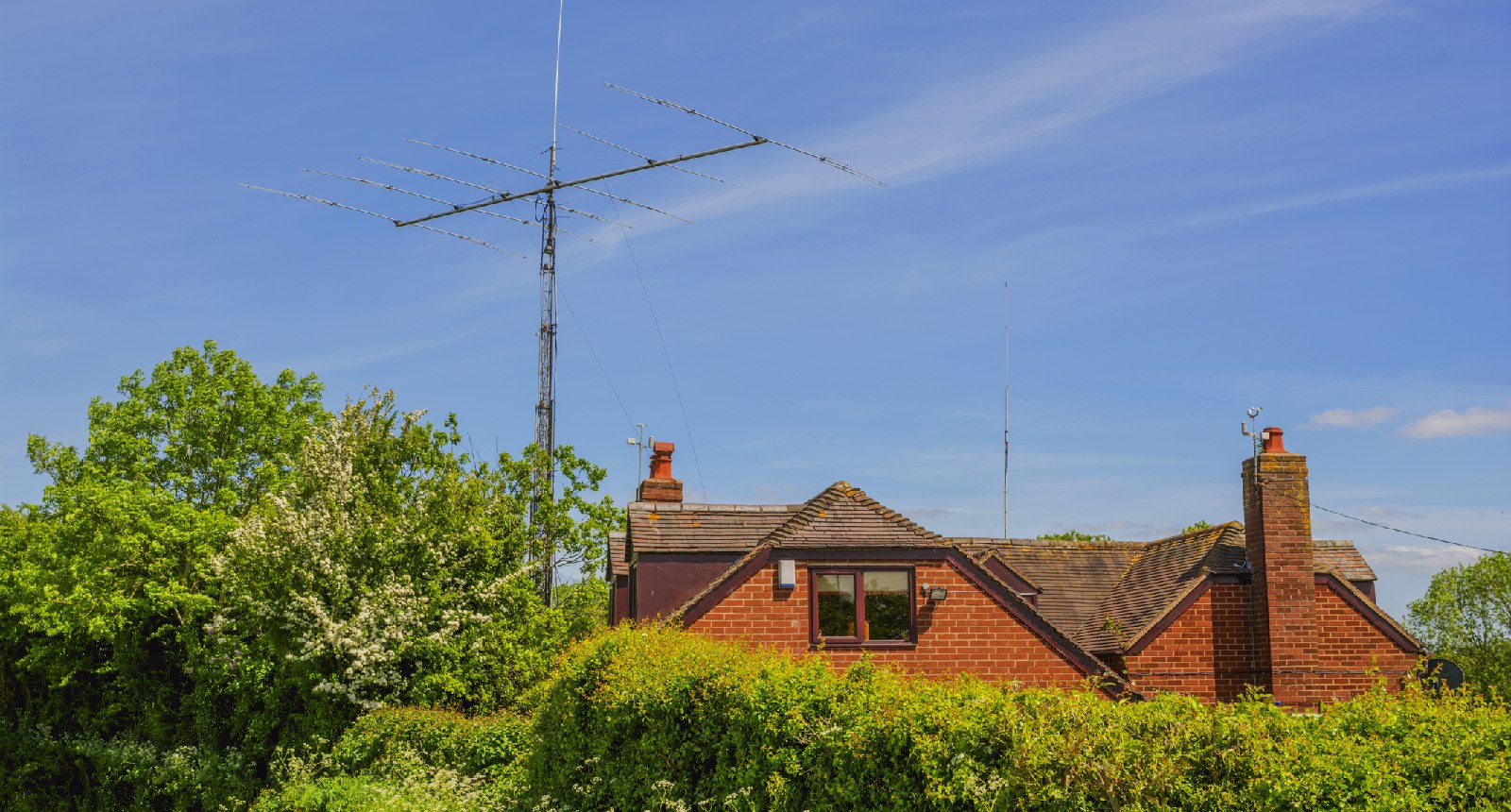
Beam antennas focus radio signals in a specific direction. This focus improves signal strength and reception quality. They are popular among amateur radio operators who want better range and clearer contacts. Beam antennas come in several types, each with unique designs and benefits. Below are common beam antenna types used in amateur radio.
Yagi Antennas
Yagi antennas are the most common beam antennas. They consist of a driven element, reflector, and several directors. These parts work together to direct the radio waves in one direction. Yagi antennas offer good gain and a narrow beamwidth. They help reduce interference from unwanted signals. They are simple to build and widely used for HF, VHF, and UHF bands.
Quad Antennas
Quad antennas use square-shaped loops instead of rods. They provide higher gain than Yagi antennas with fewer elements. The loops create a stronger and more focused signal. Quad antennas often have lower noise levels. They perform well on HF bands and are popular among serious amateur radio enthusiasts. They require more space but offer excellent directional control.
Other Directional Types
Other directional beam antennas include log-periodic and curtain arrays. Log-periodic antennas cover wide frequency ranges with moderate gain. They are useful for multi-band operations. Curtain arrays are large and complex, designed for long-distance communication. They provide very high gain and sharp directionality. These antennas are less common but valuable for advanced amateur radio setups.
Wire Antennas
Wire antennas are popular among amateur radio operators due to their simplicity and effectiveness. They use metal wires as the main radiating element. These antennas are easy to build and install, making them ideal for beginners and experienced users alike. Wire antennas work well on many frequency bands and offer good performance with low cost.
Many types of wire antennas exist, each suited for different purposes and spaces. They can be set up in various shapes and lengths to optimize signal strength. Wire antennas often require minimal support structures such as trees or poles, which makes them flexible for different environments.
End-fed Antennas
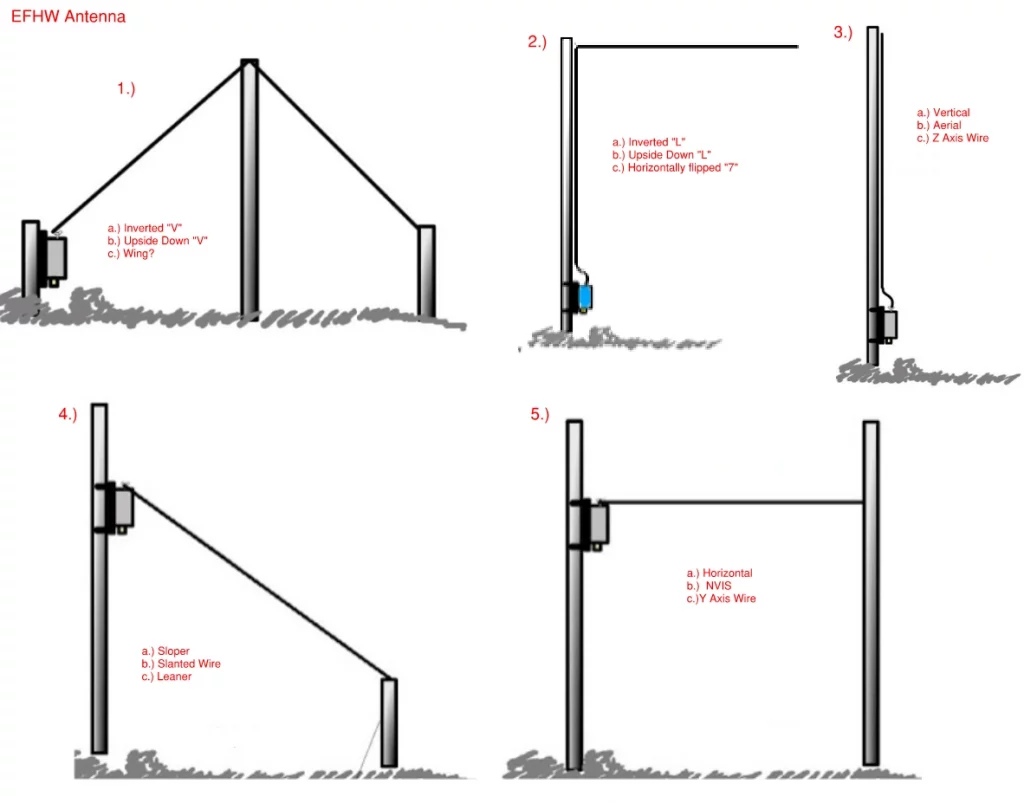
End-fed antennas use a single wire fed at one end. They are simple and need only one support point. These antennas work well for limited spaces where a full dipole is not possible. End-fed antennas often require a matching device to connect with the radio. Their easy setup makes them popular for portable operations and quick deployment.
Inverted V Antennas
The inverted V antenna is a variation of the dipole antenna. It forms a V shape with the apex supported high and the ends angled down. This design reduces the space needed compared to a straight dipole. It provides good radiation patterns and can cover multiple bands. The inverted V antenna is common in small yards and restricted areas.
Long Wire Antennas
Long wire antennas are simple wires longer than a quarter wavelength. They can be straight or bent to fit available space. These antennas cover a wide frequency range and are easy to build. Long wire antennas often require a good grounding system. They are suitable for operators who want multi-band operation without complex setups.
Mobile Antennas
Mobile antennas are essential for amateur radio enthusiasts who want to communicate while on the move. These antennas attach to vehicles, allowing operators to transmit and receive signals anywhere. Their design focuses on durability and ease of installation. Mobile antennas must handle vibrations and changing environments effectively.
Magnetic Mount Antennas
Magnetic mount antennas stick to a car’s metal surface using a strong magnet. They are quick to install and remove, making them ideal for temporary use. These antennas work well on cars, trucks, and other metal vehicles. Despite their convenience, magnetic mounts need a flat, clean surface for best performance.
Mobile Vertical Antennas
Mobile vertical antennas are fixed to the vehicle with brackets or mounts. They often use a whip-style design and provide good signal range. These antennas are more stable than magnetic mounts and handle higher power. Vertical antennas suit drivers who want a permanent setup on their vehicle.
Dual-band Options
Dual-band mobile antennas operate on two different frequency bands, usually VHF and UHF. This feature allows users to switch between bands without changing antennas. Dual-band antennas save space and reduce costs for mobile operators. They are popular among amateur radio users who want flexibility on the road.
Handheld And Qrp Antennas
Handheld and QRP antennas are essential for amateur radio operators who prefer compact, portable setups. These antennas suit low-power radios, making communication possible during outdoor activities or in limited spaces. They offer flexibility without sacrificing too much performance.
Portable Antenna Types
Common portable antennas include rubber duck, telescopic, and wire antennas. Rubber duck antennas attach directly to handheld radios and provide basic coverage. Telescopic antennas extend to improve signal strength and range. Wire antennas can be quickly set up for better performance outdoors.
Compact Designs
Compact antennas are designed to save space and weight. Many use lightweight materials like fiberglass and aluminum. Some models fold or collapse for easy transport. The goal is to balance size with durability and ease of use for portable operations.
Performance Considerations
Performance depends on frequency, antenna length, and environment. Handheld antennas often sacrifice range for convenience. QRP antennas focus on efficiency to maximize signal with low power. Placement and height also affect transmission quality. Operators must choose antennas matching their communication needs and conditions.
Multi-band And Specialty Antennas
Multi-band and specialty antennas offer ham radio operators flexibility and unique performance. These antennas allow operation on several frequency bands without changing equipment. Specialty antennas serve specific needs like space-saving or hidden installations. Understanding their types helps choose the right antenna for your radio setup.
Monoband Vs Multi-band
Monoband antennas work on one frequency band only. They often provide better performance on that single band. Multi-band antennas cover multiple frequency bands with one antenna. They save space and reduce the need for extra equipment. However, multi-band antennas may have slightly lower efficiency on some bands.
Trap And Fan Antennas
Trap antennas use traps to isolate sections for different bands. They automatically switch between bands without manual tuning. Fan antennas have multiple wires spread out like a fan. Each wire is cut for a specific band. Both designs allow multi-band use but differ in complexity and size.
Stealth And Hidden Antennas
Stealth antennas blend into the environment or stay hidden from view. They suit places with strict rules or limited space. Examples include wire antennas disguised as flagpoles or small magnetic loops. These antennas may sacrifice some performance for low visibility but keep your station discreet.
Antenna Installation Tips
Installing an amateur radio antenna correctly improves signal strength and communication range. Careful planning makes a big difference. Proper installation also ensures the antenna lasts longer and stays safe. Follow simple guidelines to get the best results.
Location And Height
Choose a clear spot away from tall buildings and trees. Higher placement usually means better signal reception and transmission. Aim for at least 20 feet above ground. Avoid metal objects nearby as they can block signals. Open spaces help antennas work efficiently.
Mounting Methods
Use strong poles or masts to support your antenna. Secure it tightly with clamps or brackets to prevent movement. Consider using rotators for directional antennas to change direction easily. Check that the mounting structure can handle wind and weather. Keep cables neat and protected from damage.
Safety Precautions
Never install antennas near power lines or electrical equipment. Use insulated tools and wear protective gear during installation. Avoid working on antennas during storms or strong winds. Make sure the antenna and mast are grounded to prevent lightning damage. Always follow local regulations for antenna installation.

Frequently Asked Questions
What Are The Main Types Of Amateur Radio Antennas?
The main types include dipole, vertical, loop, beam (Yagi), and wire antennas. Each serves different purposes and frequencies for ham radio operators.
How Does A Dipole Antenna Work In Ham Radio?
A dipole antenna uses two equal-length conductive elements to transmit and receive signals. It is simple, cost-effective, and widely used by amateurs.
Which Antenna Is Best For Long-range Amateur Radio?
Beam antennas like the Yagi provide high directionality and gain, making them ideal for long-distance communication in amateur radio.
What Are The Advantages Of Vertical Antennas?
Vertical antennas offer omnidirectional coverage and require less space. They are great for limited areas and provide good ground wave propagation.
Conclusion
Choosing the right amateur radio antenna depends on your needs and space. Dipole, vertical, loop, and beam antennas each offer unique benefits. Simple designs suit beginners, while advanced types improve signal range. Testing different antennas helps find the best fit for your setup.
Enjoy exploring amateur radio with confidence and clear communication. Keep learning and experimenting to enhance your radio experience.